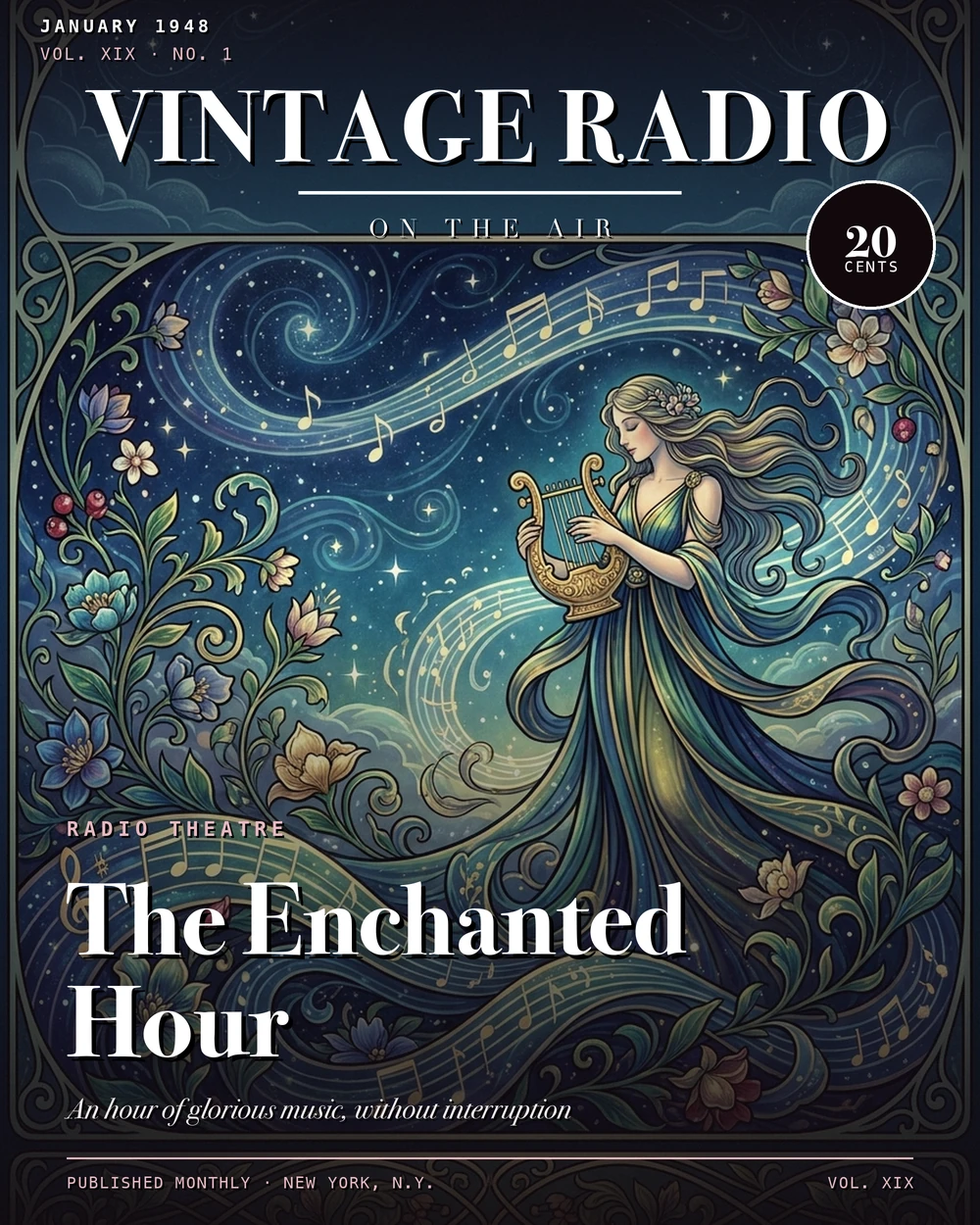
The Enchanted Hour
What the Show Actually Was
The Enchanted Hour had a clear identity and stuck to it. Premiering on September 25, 1949, and running through October 15, 1950, this Chicago-produced program offered something genuinely uncommon on the radio dial of its era: uninterrupted classical orchestral and operatic music. No comedy sketches, no variety patter, no pop numbers wedged in between. The show opened with the phrase "Let care be gone on magic wings of song… This is the Enchanted Hour" and carried the tagline "Sincerely dedicated to better radio listening for every member of your family." Those words weren't decoration — they described the format exactly.
The music played straight through, conducted by Henry Weber with his orchestra, drawing on composers including Mendelssohn, Prokofiev, Handel, Debussy, Strauss, and Wagner. Soprano Nancy Carr appeared frequently as the featured vocal soloist. The program aired coast-to-coast over WGN Chicago, with at least some broadcasts confirmed on WMAQ and WSNB, and a 1949 Chicago newspaper radio listing places it at 9:30 with Carr singing and Weber on the podium.
The Music and the Format
Each episode was structured around a featured musical piece, identified in the program's records as the "First Song" — the opening selection that set the tone for everything that followed. The range of those opening works tells you a lot about the show's ambitions. Chopin's Nocturne in C Minor led one episode; another opened with Handel's Water Music; others began with operatic material from La Bohème, a Delibes overture, or Mendelssohn's "On Wings of Song." The first surviving recorded episode, dated September 25, 1949, features Prokofiev's Classical Symphony — a good signal of how seriously the program took its classical brief from the very start.
The uninterrupted format was the defining creative choice. Most music programs of the period made room for spoken segments, sponsor messages woven into the presentation, or the kind of banter that broke the spell. The Enchanted Hour was designed around the opposite principle: the music was the program, and keeping it continuous was the point. That approach suited the show's stated purpose — to offer a genuine listening experience rather than a variety of diversions.
Henry Weber and Nancy Carr
The show rested on two performers. Henry Weber, already established as a conductor in Chicago radio — he was associated with WGN's Chicago Theater of the Air — led the orchestra through the classical and operatic repertoire. His was not a light pop orchestra adapted to a different setting; the program was built around serious orchestral performance, and Weber's background fit that brief.
Nancy Carr, born in Springfield, Ohio and raised in Chicago, was the program's featured soprano, and The Enchanted Hour was described as her featured program during its run. Her voice carried the operatic and art-song selections that punctuated the orchestral performances, including pieces like "Beautiful Art Thou My Love" and "Jewels of the Madonna." After the program ended, Carr joined the faculty of the College Conservatory of Music at the University of Cincinnati, where she taught voice for sixteen years. She also appeared as a soloist with major symphony orchestras and sang with conductor Bruno Walter for five years — a subsequent career that reflects the caliber of vocalist the show had featured.
The show's two directors, Jim Ramsey and Jack LaFrandre, guided production from Chicago. Their work kept a format that could easily have felt stiff or airless from becoming either — the pacing of episodes, the sequencing of selections, the overall atmosphere of the broadcast stayed consistent across the run.
What Survives
Sixteen episodes are held in the catalog, with a run spanning just over a year. The surviving recordings capture the range of the program's repertoire: Handel alongside Prokofiev, Delibes alongside Chopin, operatic arias alongside orchestral suites. An October 23, 1949 episode built around Handel's Water Music Suite offers a representative sample of what the program sounded like week to week — a full orchestral work given space to breathe, with Carr's voice providing the vocal dimension when the program called for it.
The short run — just over thirteen months from premiere to final known broadcast — means the catalog is contained, but what's there is consistent. The Enchanted Hour didn't reinvent itself or shift direction during its time on the air. It did one thing with apparent care for the full length of its run.